A floating weed pulls antibiotics from polluted rivers — but the biology is not that simple
Published in Environmental Sciences Europe. DOI: 10.1186/s12302-025-01275-7. Supported by FAPESP. Institution: CENA-USP.
What happens when a banned antibiotic shows up in fish that people eat for dinner?
That's the question confronting researchers who sampled lambari fish (Astyanax sp.) from the Piracicaba River in the state of Sao Paulo, Brazil. During the dry season, when lower water volumes concentrate whatever pollutants remain, they detected chloramphenicol — an antibiotic whose use in food-producing animals is explicitly prohibited in Brazil because of its toxicity. The fish, a species widely sold and consumed locally, contained concentrations in the tens of micrograms per kilogram.
That finding alone would be concerning. But the team, led by Patricia Alexandre Evangelista at the University of Sao Paulo's Center for Nuclear Energy in Agriculture (CENA-USP), didn't stop at detection. They wanted to know whether a common aquatic plant could clean the water — and whether cleaning the water would actually protect the fish.
The answers turned out to be more complicated than anyone expected.
Twelve antibiotics, two seasons, one river
The study, published in Environmental Sciences Europe and supported by FAPESP, monitored water, sediment, and fish near the Santa Maria da Serra dam, downstream of where the entire Piracicaba River basin's pollutant load accumulates. The area receives treated urban sewage, domestic effluents, agricultural runoff, and waste from aquaculture and pig farming operations.
Researchers tracked 12 antibiotics across four major classes: tetracyclines, fluoroquinolones, sulfonamides, and phenols. Sampling occurred during both rainy and dry seasons. The seasonal contrast was stark. During the rainy season, most antibiotics fell below detection limits — diluted by higher water volume. In the dry season, multiple compounds appeared at measurable levels.
The sediment told its own story. Rich in organic matter, phosphorus, calcium, and magnesium, the river bottom acts as a reservoir for these compounds. Fluoroquinolones like enrofloxacin and sulfonamides were detected in sediment at concentrations exceeding those reported in comparable studies from other countries. The concern is that these compounds don't just sit there — they can remobilize over time as conditions change.
The plant that might be a filter
Salvinia auriculata is a floating macrophyte (large aquatic plant) often treated as a nuisance — the kind of organism water managers spend effort removing. But Evangelista's team suspected it might serve as a natural sponge for pharmaceutical pollutants.
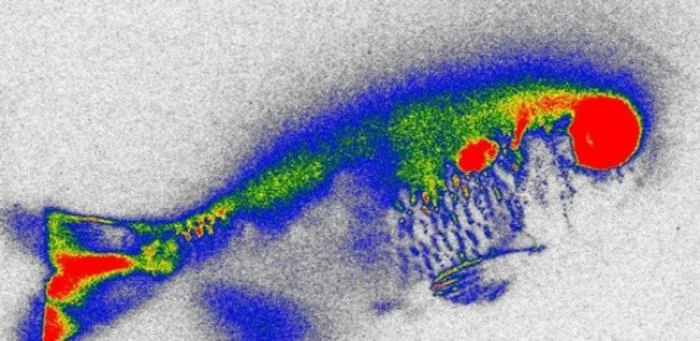
In laboratory experiments, the plant was exposed to two antibiotics at both environmental concentrations and 100-times-higher levels. The researchers used carbon-14 radiolabeled compounds — molecules tagged with a radioactive tracer — which allowed them to track precisely where the drugs ended up: in the water, in the plant, or in the fish.
For enrofloxacin, a widely used veterinary antibiotic, the results were dramatic. In tanks with higher plant biomass, Salvinia removed more than 95% of the drug from the water within days. The antibiotic's half-life in water dropped to about two to three days. Autoradiography images showed that the drugs concentrated primarily in the plant's roots, suggesting that rhizofiltration — absorption through the root system — drives the removal process.
Chloramphenicol was a harder target. The plant managed to remove 30% to 45% from the water, with half-lives of 16 to 20 days. Still meaningful, but a far cry from the near-total clearance seen with enrofloxacin.
Less drug in the water, more drug in the fish
Here's where the story takes a turn. Reducing the antibiotic concentration in the water did not always reduce absorption by the fish swimming in it.
In controlled experiments, enrofloxacin mostly stayed dissolved in water and was eliminated relatively quickly by lambari, with a half-life of about 21 days in fish tissue and a low bioconcentration factor. Chloramphenicol behaved differently — it persisted in the organism with a half-life exceeding 90 days and a high bioconcentration factor, meaning it accumulated in tissues more readily.
When Salvinia was added to the system, something unexpected happened. While the plant reduced total antibiotic levels in the water, the absorption rate by fish sometimes increased. One hypothesis: the plant may partially transform the original compound into metabolites that are more bioavailable, even though total drug concentrations are lower.
It's not that simple to use plants as sponges for contaminants. The macrophyte changes the entire system, including the chemical forms in which the fish encounters the pollutant.
DNA damage goes down — for one drug
The genotoxicity results added another layer. Chloramphenicol significantly increased DNA damage in fish, measured by the frequency of micronuclei (fragments of chromosomes that signal genetic injury) and nuclear abnormalities in blood cells. When Salvinia was present, that DNA damage dropped back toward control-group levels. The researchers propose that the plant may generate fewer genotoxic byproducts from chloramphenicol, or may release antioxidant compounds from its root zone that reduce oxidative stress in the fish.
For enrofloxacin, however, the plant's presence made no significant difference in genotoxic effects. The drug is chemically more stable and may produce persistent metabolites whose toxicity the macrophyte cannot neutralize.
A tool with caveats, not a solution
Evangelista is clear that Salvinia auriculata is not a simple fix. There are open questions about byproduct formation, about what happens when contaminated plant biomass decomposes back into the water, and about scaling from lab tanks to actual river systems. If the plant isn't harvested and properly disposed of, it becomes a secondary pollution source — reintroducing the antibiotics it absorbed.
Still, for communities where advanced treatment technologies like ozonation or oxidative processes are economically out of reach, nature-based approaches have appeal. The challenge is making them work reliably without creating new problems.
The detection of a banned antibiotic in commercially sold fish is perhaps the study's most immediate finding. Chloramphenicol is prohibited in livestock precisely because of its toxicity, yet it appeared in the food supply during dry-season conditions. The pathway — from upstream agricultural and urban sources, through river water and sediment, into the tissue of fish caught by local fishermen — represents exactly the kind of indirect human exposure route that regulation is supposed to prevent.
The study also raises broader concerns about antibiotic resistance. Persistent low-level antibiotic contamination in rivers creates selection pressure on microbial communities, potentially fostering resistant organisms. Co-author Valdemar Luiz Tornisielo noted that this resistance could lead to the emergence of resistant bacteria in the environment — a concern that extends well beyond the Piracicaba River basin.
The radiolabeled molecules used in the study were provided by the International Atomic Energy Agency (IAEA), enabling the kind of precise compound-tracking that distinguishes this work from typical environmental surveys.