THE ORIGINAL COLLECTION · SINCE 2010

Earth Science
press releases.

Research announcements from universities, hospitals and scientific institutions. Explore the stories, people and discoveries behind the headlines.

Original publication datesPage 13
FIND A STORY

Find a past release.

Dates and source material belong to the original release.

Read our research explainers

Browse the collection · original publication order

Earth Science

Study: Atmospheric circulation weakens following volcanic eruptions

The Pacific Ocean covers 32% of Earth’s surface area, more than all the land combined. Unsurprisingly, its activity affects conditions around the globe. Periodic variations in the ocean’s water temperature and winds, called the El Niño–Southern Oscillation, are a major meteorologic force. Scientists know that human activity is affecting this system, but are still determining the extent. A new study in Nature has revealed that the atmospheric component of this system — ...

Read the release
Earth Science

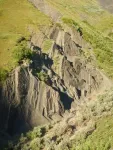
Acosta & Burls using weather model & geologic data to test tectonic mechanisms in intercontinental setting

Paul Acosta, Postdoctoral Scholar, Atmospheric, Oceanic and Earth Sciences (AOES), and Natalie Burls, Associate Professor, AOES; Graduate Program Director, Climate Dynamics, received funding from the National Science Foundation for the project: "Collaborative Research: Using a weather model and geologic data to test tectonic mechanisms in an intercontinental setting: The Altai Mountains of Central Asia." This project seeks to apply new advances in atmospheric and geosciences to ...

Read the release
Earth Science

Scientists zero in on timing, causes of ice age mammal extinctions in southern California

The end of the last Ice Age also marked the end for more than three dozen genera of large mammals in North America, from mammoths and mastodons to bison and saber-toothed cats. Details concerning the precise timing and circumstances, however, have remained murky ever since. A team of scientists that included Texas A&M University archaeologist Dr. Michael Waters recently focused on the well-known Rancho La Brea Tar Pits in southern California in their quest to provide answers to these questions, resulting in the most exact and detailed timeline for the extinctions that happened during the latter part of the Pleistocene ...

Read the release
Scientists explore dinosaur ‘coliseum’ in Denali National Park
Earth Science

Scientists explore dinosaur ‘coliseum’ in Denali National Park

University of Alaska Fairbanks scientists have discovered and documented the largest known single dinosaur track site in Alaska. The site, located in Denali National Park and Preserve, has been dubbed “The Coliseum” by researchers. The Coliseum is the size of one-and-a-half football fields and contains layer upon layer of prints preserved in rock. The site is a record of multiple species of dinosaurs over many generations that thrived in what is now Interior Alaska nearly 70 million years ago. The scientists describe the site in a paper recently published ...

Read the release
Interdisciplinary team studies decomposition effects on soil
Earth Science

Interdisciplinary team studies decomposition effects on soil

Forensic researchers at the University of Tennessee Knoxville’s famous Anthropological Research Facility, popularly known as the “Body Farm,” have made headlines for decades in their discoveries of what happens to human bodies after death. Now, a multidisciplinary team—engineers, soil scientists, and biologists—digs in with them for a deeper look at what happens to the soil underneath a decomposing body. Their study, “Soil Elemental Changes During Human Decomposition,” published in June 2023 by PLOS One, could benefit investigators searching for human remains in remote or hard-to access-vegetated areas. “This ...

Read the release
Research reveals Hawai‘i’s undersea volcano, Kama‘ehu, erupted five times in past 150 years
Earth Science

Research reveals Hawai‘i’s undersea volcano, Kama‘ehu, erupted five times in past 150 years

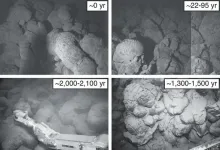
Kamaʻehuakanaloa (formerly Lōʻihi Seamount), a submarine Hawaiian volcano located about 20 miles off the south coast of the Big Island of Hawai‘i, has erupted at least five times in the last 150 years, according to new research led by Earth scientists at the University of Hawai‘i at Mānoa. For the first time, scientists were able to estimate the ages of the most recent eruptions of Kamaʻehu, as well as the ages of eight additional older eruptions at this volcano going back about 2,000 years. Their findings were published recently in Geology. Hawaiian volcanoes are thought to transition through a series of growth stages. ...

Read the release
Canadian paleontologists discover microvertebrate faunal assemblages in Manitoba, Canada
Earth Science

Canadian paleontologists discover microvertebrate faunal assemblages in Manitoba, Canada

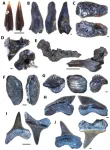
Canadian vertebrate palaeontologist, Aaron Kilmury, and a team of researchers from the University of Manitoba have published new research in PeerJ Life and Environment, unveiling the first-ever formal description of microvertebrate fossil assemblages from the late Cenomanian to middle Turonian periods in Manitoba, Canada. “One of the most significant findings of this study is that the new microvertebrate material described from Manitoba shares several similarities with microvertebrate assemblages collected ...

Read the release
Fiber optic cables detect and characterize earthquakes
Earth Science

Fiber optic cables detect and characterize earthquakes

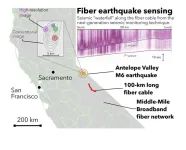
In California, thousands of miles of fiber optic cables crisscross the state, providing people with internet. But these underground cables can also have a surprising secondary function: they can sense and measure earthquakes. In a new study at Caltech, scientists report using a section of fiber optic cable to measure intricate details of a magnitude 6 earthquake, pinpointing the time and location of four individual asperities, the "stuck" areas of the fault, that led to the rupture. For several years, Professor of Geophysics Zhongwen Zhan (PhD '14) ...

Read the release
Texas A&M chemists, geologists bond over NSF-funded study of clumped isotopes
Earth Science

Texas A&M chemists, geologists bond over NSF-funded study of clumped isotopes

Carbon dioxide levels in Earth’s atmosphere — and, consequently, ocean temperatures — are rising. How high and how fast ocean temperatures can rise can be learned from temperature measurements of ancient oceans. At the same time, energy exploration also relies on knowing the thermal history of oil and gas source rocks, which is often difficult to determine. One of the most promising techniques for measuring ancient ocean temperatures and basin thermal histories relies on the co-enrichment of rare heavy oxygen and heavy carbon ...

Read the release
How to distinguish slow and fast earthquakes
Earth Science

How to distinguish slow and fast earthquakes

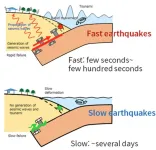
Researchers from the University of Tokyo and Stanford University show what differentiates slow and fast earthquakes and how their magnitudes vary with time. Normally, earthquakes last up to a few minutes and radiate strong seismic waves. But around 23 years ago, scientists discovered an unusual slow-slip phenomena called slow earthquakes. Slow earthquakes last days or even months. Though they involve significant tectonic movement, you may never feel them. Since slow earthquakes could indicate future fast earthquakes, monitoring and ...

Read the release
Bees evolved from ancient supercontinent, diversified faster than suspected
Earth Science

Bees evolved from ancient supercontinent, diversified faster than suspected

The first bees evolved on an ancient supercontinent more than 120 million years ago, diversifying faster and spreading wider than previously suspected, a new study shows. Led by Washington State University researchers, the study provides a new best estimate for when and where bees first evolved. Newly published in the journal Current Biology, the project reconstructed the evolutionary history of bees, estimated their antiquity, and identified their likely geographical expansion around the world. The results indicate their point of origin was in western Gondwana, an ancient supercontinent that at that time included today's continents of Africa and South America. “There’s ...

Read the release
Bees likely evolved from ancient supercontinent, earlier than suspected
Earth Science

Bees likely evolved from ancient supercontinent, earlier than suspected

PULLMAN, Wash. –The origin of bees is tens of millions of years older than most previous estimates, a new study shows. A team led by Washington State University researchers traced the bee genealogy back more than 120 million years to an ancient supercontinent, Gondwana, which included today’s continents of Africa and South America. In a study that proposes a new evolutionary history of bees, the researchers found evidence that bees originated earlier, diversified faster and spread wider than many scientists previously suspected. They published their findings in the journal Current ...

Read the release
Nematode resurrected from Siberian permafrost laid dormant for 46,000 years
Earth Science

Nematode resurrected from Siberian permafrost laid dormant for 46,000 years

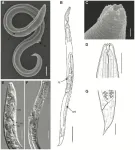
A soil nematode reanimated from Siberian permafrost had laid dormant for approximately 46,000 years, according to a study publishing July 27, 2023 in the open access journal PLOS Genetics by Anastasia Shatilovich at the Institute of Physicochemical and Biological Problems in Soil Science RAS in Russia, Vamshidhar Gade at the Max Planck Institute for Molecular Cell Biology and Genetics in Germany, and colleagues. Some animals, such as tardigrades, rotifers, and nematodes, can survive harsh conditions by entering a dormant state known as “cryptobiosis”. Previously, nematode individuals were reanimated from samples collected from a fossilized burrow in silt deposits ...

Read the release
Geological Society of America announces 2023–2024 Fellows for Science Policy and Communication
Earth Science

Geological Society of America announces 2023–2024 Fellows for Science Policy and Communication

27 July 2023 Geological Society of America Release No. 23-28 Contact: Justin Samuel +1-303-357-1026 jsamuel@geosociety.org Boulder, Colo., USA: GSA is pleased to welcome three exceptional new Fellows who will join us in our mission to advance geoscience knowledge and discovery through excellent writing, research, and advocacy. GSA’s 2023–2024 Science Communication Fellow is Arianna Soldati. Soldati is an assistant professor of volcanology at North Carolina State University. Her lab group works on a variety of topics, ranging from effusive eruptions to critical minerals. She received her Ph.D. in geological sciences from the University of ...

Read the release
Earth Science

What can central Utah’s earthquake ‘swarms’ reveal about the West’s seismicity?

Most of the earthquakes rumbling under the West’s Great Basin come in surges, clustered together in time and place. Scientists call these seismic groups “swarms,” which are a distinct category from the numerous aftershocks following a big shake, such as the 5.7 magnitude Magna quake of 2020 on the Wasatch Fault. Rather than getting spread out evenly over time, many of these small, often imperceptible quakes strike a region in a short period of time, say a few days or weeks. Central Utah has been the stage for dozens of earthquake swarms that have been recorded over the past 40 years by an ever-expanding network of seismic arrays managed by the University ...

Read the release
New study uncovers potential risk of arsenic release from sediment under organic matter influence
Earth Science

New study uncovers potential risk of arsenic release from sediment under organic matter influence

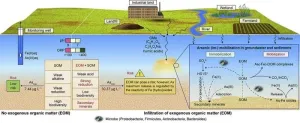
Researchers from the Chinese Research Academy of Environmental Sciences have conducted a study to assess the impact of environmental factors and microbial communities on the mobilization of arsenic (As). The findings, published in Volume 15 of the journal Environmental Science and Ecotechnology, reveal important insights into the biogeochemical processes involved in As release. The study focused on processes such as desorption, reduction, complexation, and co-precipitation that affect the As behaviour in the environment. The interaction ...

Read the release
Earth Science

Global GPS measurements indicate observable phase of fault slip two hours before large earthquakes

Analysis of Global Positioning System (GPS) time-series data from nearly 100 large earthquakes worldwide has provided evidence for the existence of a precursory phase of fault slip occurring two hours before seismic rupture. “If it can be confirmed that earthquake nucleation often involves an hours-long precursory phase, and the means can be developed to reliably measure it, a precursor warning could be issued,” writes Roland Bürgmann in a related Perspective. The ability to predict large earthquakes has been a longstanding yet elusive goal. Short-term ...

Read the release
Earth Science

Risk assessment for fluoride in groundwater of Mihe-Weihe River Basin——a region with a high fluorine content in the groundwater of Shandong Peninsula in China

Due to the unclear distribution characteristics and causes of fluoride in groundwater of Mihe-Weihe River Basin (China), there is a higher risk for the future development and utilization of groundwater. Based on the systematic sampling and analysis, a team of researchers from Shandong University of Science and Technology studied the distribution features and enrichment mechanism for fluoride in groundwater by the graphic method, hydrogeochemical modeling, the proportionality factor between conventional ions and factor analysis. Their analysis is published in the journal Frontiers of Environmental Science & Engineering ...

Read the release
Earth Science

Geological Society of America announces 2023–2024 Officers and Councilors

13 July 2023 The Geological Society of America Release no. 23-26 Contact: Justin Samuel +1-303-357-1026 jsamuel@geosociety.org For Immediate Release Geological Society of America Announces 2023–2024 Officers and Councilors Boulder, Colo., USA: Christopher (Chuck) M. Bailey, College of William & Mary, Williamsburg, Virginia, takes over the role of president of The Geological Society of America as of 1 July 2023. The incoming president-elect is Carmala N. Garzione, University of Arizona, Tucson, Arizona. Rounding ...

Read the release
Earth Science

Enhanced dominance of soil moisture stress on vegetation growth in Eurasian drylands

In a new study, a group from Institute of Geographic Science and Natural Resources Research, Chinese Academy of Sciences, proposed a concept of ecosystem water stress and comprehensively compared the impacts of high atmospheric vapor pressure deficit and low soil water content on vegetation growth in Eurasian drylands Drought, a multifaceted phenomenon encompassing atmospheric and soil drought, has sparked a lively debate over which type of dryness stress exerts a more significant impact on vegetation growth. "Through our defined concept of ecosystem water stress, we can discern where water-stressed vegetation growth is dominated by ...

Read the release
Giant stone artefacts found on rare Ice Age site in Kent
Earth Science

Giant stone artefacts found on rare Ice Age site in Kent

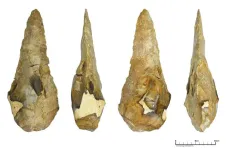
UCL press release Under embargo until Thursday, 6 July 2023, 00:01 London time Giant stone artefacts found on rare Ice Age site in Kent Researchers at the UCL Institute of Archaeology have discovered some of the largest early prehistoric stone tools in Britain. The excavations, which took place in Kent and were commissioned in advance of development of the Maritime Academy School in Frindsbury, revealed prehistoric artefacts in deep Ice Age sediments preserved on a hillside above the Medway Valley. The researchers, from UCL Archaeology South-East, discovered 800 stone artefacts thought to be over 300,000 years old, buried in sediments which filled a sinkhole and ...

Read the release
Earth Science

Researchers find eruption date of Laacher See volcano is wrong by 130 years

-With pictures- In a new study, a group of scientists argue that the new high precision radiocarbon-based date set for Laacher See volcano eruption of 13,000 years before present is probably not correct. They argue that the correct age of the Laacher See volcano eruption is 12,880 years ago, 130 years after the date presented by Reinig et al., in 2021. The research team, which included scientists from Durham University, University of Oxford, Royal Holloway University of London, SYSTEMIQ Ltd. and Teesside University ...

Read the release
Earth Science

Utah seismologist peer into Earth's inner core

Media contacts: --Keith Koper, professor, Department of Geology and Geophysics, University of Utah, keith.koper@utah.edu 801-585-3669 --Brian Maffly, research communications, University of Utah, brian.maffly@utah.edu 801-573-2382 --Syl Kacapyr, Cornell Engineering, Associate Director, Marketing and Communications vpk6@cornell.edu 607.339.6450 At the center the Earth is a solid metal ball, a kind of “planet within a planet,” whose existence makes life on the surface possible, at least as we know it. How Earth’s inner core formed, grew and evolved over ...

Read the release
Earth Science

Research reveals sources of CO2 from Aleutian-Alaska Arc volcanoes

Scientists have wondered what happens to the organic and inorganic carbon that Earth’s Pacific Plate carries with it as it slides into the planet’s interior along the volcano-studded Ring of Fire. A new study suggests a notable amount of such subducted carbon returns to the atmosphere rather than traveling deep into Earth’s mantle. The finding can improve long-term projections about Earth’s climate. A study led by a University of Alaska Fairbanks Geophysical Institute scientist has shown that volcanoes of the Aleutian-Alaska Arc return more subducted slab carbon to the atmosphere as carbon dioxide than previously thought. This occurs ...

Read the release
FSU assistant professor’s research helps determine origins of plate tectonics
Earth Science

FSU assistant professor’s research helps determine origins of plate tectonics

A Florida State University faculty member’s research is helping to uncover more about the conditions necessary for the beginnings of life on Earth. FSU Assistant Professor Richard Bono was part of a multi-institution team that found evidence that the planet’s magnetic field was stable from 3.9 to 3.4 billion years ago, a time when scientists think life may have first originated. Their research was published in Nature. Bono explained more about what the team found and its implications for the origins of plate tectonics and life on Earth. What did the research team find? Our research showed ...

Read the release
From the original Press-News collection. Issuers of news releases are responsible for the accuracy of their content.