THE ORIGINAL COLLECTION · SINCE 2010

Earth Science
press releases.

Research announcements from universities, hospitals and scientific institutions. Explore the stories, people and discoveries behind the headlines.

Original publication datesPage 9
FIND A STORY

Find a past release.

Dates and source material belong to the original release.

Read our research explainers

Browse the collection · original publication order

NARO developed a novel method to analyze “forever chemicals” in the soil
Earth Science

NARO developed a novel method to analyze “forever chemicals” in the soil

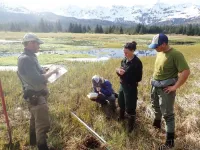
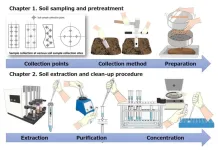
Concern about the effects of PFAS are of increasing globally. Also there is no accurate method for analyzing multiple PFAS in soil. Hence, a team of PFAS researchers led by NARO et.al sought to develop a stable and accurate method for analyzing multicomponent PFAS in the soil (Ministry of Agriculture, Forestry and Fisheries -MAFF project). Unlike the PFAS analysis method for water samples, it is difficult to ensure the extraction efficiency of the target PFAS in diverse soil samples. In Japan, there are 381 soil types, with volcanic ash soils being the predominant. Since these soils possess high carbon content, ...

Read the release
Sixty-million-year-old grape seeds reveal how the death of the dinosaurs may have paved the way for grapes to spread
Earth Science

Sixty-million-year-old grape seeds reveal how the death of the dinosaurs may have paved the way for grapes to spread

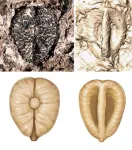
If you’ve ever snacked on raisins or enjoyed a glass of wine, you may, in part, have the extinction of the dinosaurs to thank for it. In a discovery described in the journal Nature Plants, researchers found fossil grape seeds that range from 60 to 19 million years old in Colombia, Panama, and Peru. One of these species represents the earliest known example of plants from the grape family in the Western Hemisphere. These fossil seeds help show how the grape family spread in the years following the death of the dinosaurs. “These are the oldest grapes ever found in this part of the world, and they’re a few million years ...

Read the release
Ammonites’ fate sealed by meteor strike that wiped out dinosaurs
Earth Science

Ammonites’ fate sealed by meteor strike that wiped out dinosaurs

Ammonites were not in decline before their extinction, scientists have found. The marine molluscs with coiled shells and one of palaeontology’s great icons flourished in Earth’s oceans for more than 350 million years until they died out during the same chance event that wiped out the dinosaurs 66 million years ago. Some palaeontologists have argued that their demise was inevitable and that ammonite diversity was decreasing long before they went extinct at the end of the Cretaceous. However new research, published today in Nature Communications and led by palaeontologists at the ...

Read the release
Potential long-term volcanic activity on Iceland's Reykjanes Peninsula
Earth Science

Potential long-term volcanic activity on Iceland's Reykjanes Peninsula

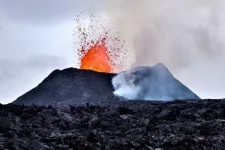
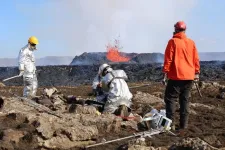
Given the volcanic activity on Iceland over the last three years, researchers from six universities anticipate recurring, moderately sized eruptions of similar style in the coming years to decades. They therefore stress the need for preparedness in view of the risks posed to local populations and critical infrastructure. Their study was recently published in the scientific journal Terra Nova. “The study uses information from local earthquakes and geochemical data on the erupted magma through time to reveal the geological processes behind these recent Icelandic eruptions. A comparison of these eruptions with historical events provides strong evidence that Iceland will ...

Read the release
Iceland’s volcano eruptions may last decades, researchers find
Earth Science

Iceland’s volcano eruptions may last decades, researchers find

Iceland’s ongoing volcanic eruptions may continue on and off for years to decades, threatening the country’s most densely populated region and vital infrastructure, researchers predict from local earthquake and geochemical data. The eruptions on the Reykjanes Peninsula have forced authorities to declare a state of emergency, with a series of eight eruptions having occurred since 2021. This southwestern region is home to 70 percent of the country’s population, its only international airport, and several geothermal power plants that supply ...

Read the release
Earth Science

Should Iceland expect continued volcanic eruptions?

Research published in Terra Nova provides insights into the ongoing eruption series on the Reykjanes Peninsula in Iceland that began in 2021. The eruptions forced the evacuation of an entire town, with an uncertain future about the possibility for residents to return. For the study, investigators analyzed information from local earthquakes and geochemical data on lava samples erupted through time. The combined evidence implies that the lavas that have erupted in recent years were derived from a moderately-sized magma reservoir ...

Read the release
Newly discovered dinosaur boasts big, blade-like horns
Earth Science

Newly discovered dinosaur boasts big, blade-like horns

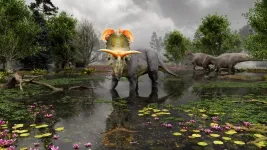
What do you get when you cross Norse mythology with a 78-million-year-old ancestor to the Triceratops? Answer: Lokiceratops rangiformis, a plant-eating dinosaur with a very fancy set of horns. The new dinosaur was identified and named by Colorado State University affiliate faculty member Joseph Sertich and University of Utah Professor Mark Loewen. The dinosaur’s name, announced today in the scientific journal PeerJ, translates roughly to “Loki’s horned face that looks like a caribou.” Loewen and Sertich, co-lead authors of the PeerJ study, dubbed the new species Lokiceratops (lo-Kee-sare-a-tops) ...

Read the release
At least one in four US residential yards exceed new EPA lead soil level guideline
Earth Science

At least one in four US residential yards exceed new EPA lead soil level guideline

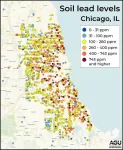
American Geophysical Union Press release 24-26 18 June 2024 For Immediate Release This press release is available online at: https://news.agu.org/press-release/millions-households-exceed-soil-lead-epa/ At least one in four US residential yards exceed new EPA lead soil level guideline Nearly 40% of households will exceed safety recommendations where multiple lead sources may exist. Remediation with standard techniques at this scale could cost more than $1 trillion nationally AGU press contact: Rebecca Dzombak, news@agu.org (UTC-4 hours) Contact information ...

Read the release
Earth Science

New study shows mechanisms of Hagfish burrowing into deep sea sediment

Scientists at the Schmid College of Science and Technology at Chapman University developed a novel way to observe the elusive burrowing behavior of hagfish. Dr. Douglas S Fudge and his team created a specialized tank of transparent gelatin in order to visualize how the hagfish behave and locomote within sediments. Hagfishes are bottom-dwelling marine animals that are capable of producing startling amounts of defensive slime when they are provoked. Understanding the burrowing activities of hagfishes could lead to increased knowledge of sediment turnover in marine benthic habitats, new insights into the reproductive behavior of hagfishes or ...

Read the release
An earthquake changed the course of the Ganges. Could it happen again?
Earth Science

An earthquake changed the course of the Ganges. Could it happen again?

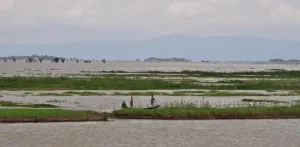
A major earthquake 2,500 years ago caused one of the largest rivers on Earth to abruptly change course, according to a new study. The previously undocumented quake rerouted the main channel of the Ganges River in what is now densely populated Bangladesh, which remains vulnerable to big quakes. The study was just published in the journal Nature Communications. Scientists have documented many river-course changes, called avulsions, including some in response to earthquakes. However, “I don’t think we have ever seen such a big ...

Read the release
Earth Science

New study emphasizes tradeoffs between arresting groundwater depletion and food security

Washington DC, June 14, 2024: A study by authors from the International Food Policy Research Institute (IFPRI), published today in Nature Sustainability, reaffirms the world’s growing dependence on depleting groundwater systems. Although efforts to slow down groundwater depletion need to be urgently accelerated, this study indicates that such efforts – in the absence of other accompanying measures – would likely lead to significant food security impacts. The study finds that ending groundwater depletion would lead to sharp declines in food production, ...

Read the release
Roots of resistance: unveiling the soil-saving secrets of grafting
Earth Science

Roots of resistance: unveiling the soil-saving secrets of grafting

Grafting, an age-old horticultural technique, has been revealed as a powerful tool against soil-borne diseases like crown gall. New research uncovers how the composition of root exudates changes when plants are grafted onto resistant rootstocks, creating a defensive mechanism that reduces the prevalence of pathogenic Agrobacterium. Crown gall disease, a destructive plant ailment caused by Agrobacterium, has long plagued agriculture, leading to significant crop losses. Traditional control methods have proven inadequate, highlighting an urgent need for innovative solutions. Given the pervasive impact of this disease and the limitations ...

Read the release
Earth Science

YALE NEWS: Mapping the seafloor sediment superhighway

New Haven, Conn. — A new scientific model is giving researchers an unprecedented, global look at the activities of clams, worms, and other invertebrate animals that burrow at the bottom of the ocean. And what they find may offer new insights into how these mud-churning species affect ocean chemistry, carbon sequestration, and the ability of marine life to thrive globally. Scientists have long debated the role of “bioturbation” — the excavation and stirring up of seafloor sediments caused by these species. Part of the challenge has come from trying to understand how the interactions between these animals and their surroundings influence bioturbation patterns ...

Read the release
SwRI-led team to bolster earthquake readiness for U.S. Federal Highway Administration
Earth Science

SwRI-led team to bolster earthquake readiness for U.S. Federal Highway Administration

SAN ANTONIO — June 3, 2024 — Southwest Research Institute will enhance models to strengthen the earthquake resilience of America’s transportation infrastructure and improve public safety in earthquake-prone areas. As part of a contract with the U.S. Federal Highway Administration (FHWA), an SwRI-led team will update and improve liquefaction models. Liquefaction occurs during an earthquake when intense shaking causes soil to temporarily act more like a fluid, losing its capacity to support roads and structures. “For highways specifically, sometimes state and ...

Read the release
Musankwa sanyatiensis, a new dinosaur from Zimbabwe
Earth Science

Musankwa sanyatiensis, a new dinosaur from Zimbabwe

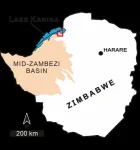
Fossils found on the shoreline of Lake Kariba in Zimbabwe represent a completely new dinosaur species. This remarkable find, named Musankwa sanyatiensis, marks only the fourth dinosaur species named from Zimbabwe. The research detailing this significant discovery is set to be published in the prestigious journal Acta Palaeontologica Polonica. The study was conducted by an international team of scientists from the University of the Witwatersrand (Wits) in South Africa, the Natural History Museum of Zimbabwe, Stony Brook University in New York and was led by Prof Paul Barrett from the Natural History Museum ...

Read the release
Earth Science

Earth scientists describe a new kind of volcanic eruption

No two volcanic eruptions are exactly alike, but scientists think a series of explosive eruptions at Kīlauea volcano fit into a whole new category. By analyzing the dynamics of 12 back-to-back explosions that happened in 2018, researchers describe a new type of volcanic eruption mechanism. The explosions were driven by sudden pressure increases as the ground collapsed, which blasted plumes of rock fragments and hot gas into the air, much like a classic stomp-rocket toy. Researchers from the University of Oregon, United States Geological Survey and China’s Sichuan University report their findings in a paper published May 27 in Nature Geoscience. The ...

Read the release
Rising temperatures will significantly reduce streamflow in the upper Colorado river basin as groundwater levels fall, new research shows
Earth Science

Rising temperatures will significantly reduce streamflow in the upper Colorado river basin as groundwater levels fall, new research shows

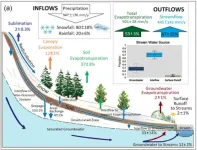
The Colorado River makes life possible in many Western cities and supports agriculture that sustains people throughout the country. Most of the river’s water begins as snowmelt from the mountainous watersheds of Colorado, Utah, and Wyoming, and a warming climate will drastically reduce these streamflows, new research finds. Researchers from Desert Research Institute (DRI), USGS, and Lawrence Berkeley National Laboratory teamed up for the new study, published May 23 in Nature Water. By applying warming to historical conditions for the East River in Colorado and using computer simulations to observe the impact on streamflow and groundwater ...

Read the release
Earth Science

Beach erosion will make Southern California coastal living five times more expensive by 2050, USC study predicts

Contact: Nina Raffio, raffio@usc.edu or (213) 442-8464 Rising sea levels and urban development are accelerating coastal erosion at an alarming rate in Southern California with significant ripple effects on the region’s economy, a USC study reveals. The study, published in Communications Earth & Environment, predicts that Southern California’s coastal living costs will surge fivefold by 2050 as a direct result of beach erosion. This erosion will require more frequent and costly beach nourishment projects to maintain the state’s treasured shorelines, consequently driving up the cost of living along the coast. “Our ...

Read the release
Highly sensitive fiber optic gyroscope senses rotational ground motion around active volcano
Earth Science

Highly sensitive fiber optic gyroscope senses rotational ground motion around active volcano

WASHINGTON — Researchers have built a prototype fiber optic gyroscope for high resolution, real-time monitoring of ground rotations caused by earthquakes in the active volcanic area of Campi Flegrei in Naples, Italy. A better understanding of the seismic activity in this highly populated area could improve risk assessment and might lead to improved early warning systems. “When seismic activity occurs, the Earth’s surface experiences both linear and rotational movements,” said research team leader Saverio Avino from the Consiglio Nazionale delle Ricerche Istituto Nazionale di Ottica (CNR-INO) ...

Read the release
Researchers discover hidden step in dinosaur feather evolution
Earth Science

Researchers discover hidden step in dinosaur feather evolution

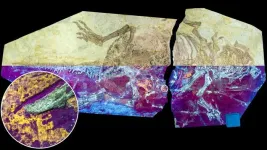
Scientists discover ‘zoned development’ in dinosaur skin, with zones of reptile-style scales and zones of bird-like skin with feathers New dinosaur skin fossil found to be composed of silica – the same as glass Discovery sheds light on evolution from scales to feathers Palaeontologists at University College Cork (UCC) in Ireland have discovered that some feathered dinosaurs had scaly skin like reptiles today, thus shedding new light on the evolutionary transition from scales to feathers. The researchers studied a new specimen of the feathered dinosaur Psittacosaurus from the early Cretaceous ...

Read the release
New research reveals that prehistoric seafloor pockmarks off the California coast are maintained by powerful sediment flows
Earth Science

New research reveals that prehistoric seafloor pockmarks off the California coast are maintained by powerful sediment flows

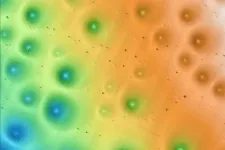
New MBARI research on a field of pockmarks—large, circular depressions on the seafloor—offshore of Central California has revealed that powerful sediment flows, not methane gas eruptions, maintain these prehistoric formations. A team of researchers from MBARI, the United States Geological Survey (USGS), and Stanford University published their findings today in the Journal of Geophysical Research: Earth Surface. This work provides important information to guide decision-making about responsible use and management of the seafloor off California, including site assessments for the development of offshore wind farms. The Sur Pockmark Field—an area about the size ...

Read the release
Improving the effectiveness of earthquake early warning systems
Earth Science

Improving the effectiveness of earthquake early warning systems

Mobile phones have become invaluable for receiving emergency alerts such as weather warnings, evacuation notices and notifications about missing persons. In Japan, where earthquakes are frequent, they are vital for delivering earthquake warnings and advising people to take protective actions beforehand. To deal with such situations promptly, the Earthquake Early Warning (EEW) system sends out notifications to areas expected to experience strong tremors by detecting primary seismic waves (P-waves) that arrive before the secondary waves (S-waves). However, the short time between receiving the notification and the arrival of S-waves ...

Read the release
Subduction zone splay faults compound hazards of great earthquakes
Earth Science

Subduction zone splay faults compound hazards of great earthquakes

Groundbreaking research has provided new insight into the tectonic plate shifts that create some of the Earth’s largest earthquakes and tsunamis. “This is the first study to employ coastal geology to reconstruct the rupture history of the splay fault system,” said Jessica DePaolis, postdoctoral fellow in Virginia Tech's Department of Geosciences. “These splay faults are closer to the coast, so these tsunamis will be faster to hit the coastline than a tsunami generated only from ...

Read the release
Earth Science

Clues from deep magma reservoirs could improve volcanic eruption forecasts

New research into molten rock 20km below the Earth’s surface could help save lives by improving the prediction of volcanic activity. Volcanic eruptions pose significant hazards, with devastating impacts on both people living nearby and the environment. They are currently predicted based on activity of the volcano itself and the upper few kilometres of crust beneath it, which contains molten rock potentially ready to erupt. However, new research highlights the importance of searching for ...

Read the release
Earth Science

Study: Heavy snowfall and rain may contribute to some earthquakes

When scientists look for an earthquake’s cause, their search often starts underground. As centuries of seismic studies have made clear, it’s the collision of tectonic plates and the movement of subsurface faults and fissures that primarily trigger a temblor. But MIT scientists have now found that certain weather events may also play a role in setting off some quakes. In a study appearing today in Science Advances, the researchers report that episodes of heavy snowfall and rain likely contributed to ...

Read the release
From the original Press-News collection. Issuers of news releases are responsible for the accuracy of their content.