THE ORIGINAL COLLECTION · SINCE 2010

Environment
press releases.

Research announcements from universities, hospitals and scientific institutions. Explore the stories, people and discoveries behind the headlines.

Original publication datesPage 64
FIND A STORY

Find a past release.

Dates and source material belong to the original release.

Read our research explainers

Browse the collection · original publication order

Environment

Pristine asteroid samples reveal secrets of the ancient solar system

Curtin University researchers have gained an unprecedented glimpse into the early history of our solar system through some of the most well-preserved asteroid samples ever collected, potentially transforming our understanding of planetary formation and the origins of life. Experts from Curtin’s School of Earth and Planetary Sciences were selected to be amongst the first in the world to inspect samples collected during NASA’s seven-year, OSIRIS-REx mission to the ancient asteroid Bennu. Asteroid Bennu is thought to be made of rubble fragments from a 4.5-billion-year-old parent body, containing materials that originated ...

Read the release
Environment

Antarctic ice sheet faces “death by a thousand cuts”

Arecent study conducted by University of Florida geologists and geographers has shed new light on the effects of climate change on Antarctic ice shelves. It found that while there has been broad ice shelf loss due to warming temperatures, the frequency and size of major iceberg calving events has not changed significantly. This study was led by Assistant Professor of Geological Sciences Emma MacKie, Ph.D., and Assistant Professor of Geography Katy Serafin, Ph.D., along with a collaborator at the Colorado School of Mines. “Our results suggest that the primary threat ...

Read the release
Environment

Mapping Antarctica’s hidden ice-free lands: a blueprint for conservation

Antarctica, often regarded as the planet’s last true wilderness, harbours unique ecosystems that support extraordinary biodiversity and contribute to global diversity and environmental stability. These ecosystems, which occupy permanently ice-free land covering less than 0.5% of the continent, are now under growing threat from human activity and climate change. Now, a team led by researchers at UNSW Sydney’s Centre for Ecosystem Science has developed a high-resolution map and hierarchical classification system of Antarctica’s ice-free lands, which can be seen in full in Scientific Data. This new inventory categorizes Antarctica’s ecosystems ...

Read the release
Environment

Plant-based substitute for fossil fuels developed for plastic foams

PULLMAN, Wash. — An environmentally-friendly preparation of plant material from pine could serve as a substitute for petroleum-based chemicals in polyurethane foams. The innovation could lead to more environmentally friendly versions of foams used ubiquitously in products such as kitchen sponges, foam cushions, coatings, adhesives, packaging and insulation. The global market for polyurethane totaled more than $75 billion in 2022. A Washington State University-led research team used an environmentally-friendly preparation of lignin as a substitute for 20% of the fossil fuel-based chemicals in the foam. The bio-based foam ...

Read the release
Q&A: How rate of CO2 rise can affect a global ocean current
Environment

Q&A: How rate of CO2 rise can affect a global ocean current

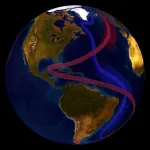
As we burn fossil fuels, the amount of carbon dioxide in Earth’s atmosphere is gradually rising, and with it, the planet’s average temperature. How fast the level of atmospheric carbon dioxide — and with it, the temperature — goes up matters for the ability of humans and ecosystems to adjust. A slower increase gives humans time to move away from low-lying coasts and animals time to move to new habitats. It turns out the rate of that increase matters for non-living systems, too. A recent University of Washington study looked at how a major current in the Atlantic Ocean that includes the Gulf Stream will respond ...

Read the release
Environment

Researchers enhance wildlife studies with novel prey measurement technique using animal-borne cameras

A team of international scientists, led by researchers from the University of Otago, has introduced a groundbreaking method to improve the accuracy of prey size estimation using footage captured by animal-borne cameras. This innovative approach, published in PeerJ Life and Environment, enhances our understanding of predator-prey interactions in natural habitats by refining a critical tool for ecological research. Animal-borne cameras, such as the "PenguCams" used in this study, allow ...

Read the release
Environment

Ocean-surface warming four times faster now than late-1980s

The rate of ocean warming has more than quadrupled over the past four decades, a new study has shown. Ocean temperatures were rising at about 0.06 degrees Celsius per decade in the late 1980s, but are now increasing at 0.27 degrees Celsius per decade. Published today (Tuesday, 28 January 2025) in Environmental Research Letters, the study helps explain why 2023 and early 2024 saw unprecedented ocean temperatures. Professor Chris Merchant, lead author at the University of Reading, said: “If the oceans were a bathtub of water, then in the 1980s, the hot tap was running slowly, warming up ...

Read the release
Environment

Floating solar increases greenhouse gas emissions on small ponds

ITHACA, N.Y. – While floating solar – the emerging practice of putting solar panels on bodies of water – is promising in its efficiency and its potential to spare agricultural and conservation lands, a new experiment finds environmental trade-offs. In the first manipulative field study examining the environmental impacts of floating solar, published in Environmental Science and Technology, researchers found that floating solar panels increased greenhouse gas emissions on small ponds by nearly 27%. “There ...

Read the release
Underwater mud volcanos are a haven for marine organisms
Environment

Underwater mud volcanos are a haven for marine organisms

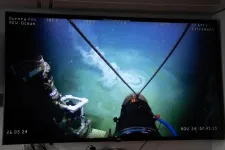
The underwater volcano Borealis Mud Volcano is located in the Barents Sea and was first discovered by researchers at UiT The Arctic University of Norway in 2023. The discovery received a lot of attention, and images of the volcano circulated around the world. Now researchers from UiT, in collaboration with REV Ocean, have finally published the results from an interdisciplinary investigation showing that Borealis mud volcano has a unique ecological role as a natural sanctuary for several marine species in the Barents Sea. While some parts of the ...

Read the release
Environment

Climate study: Rise in heat deaths will substantially outweigh fewer cold deaths

Climate change will likely result in a significant rise in deaths from heat across Europe, substantially surpassing any decrease in cold-related deaths. This trend persists across climate change scenarios and even under high adaptation to heat, reinforcing the need for aggressive mitigation policies. A modelling study, led by researchers from the Environment & Health Modelling (EHM) Lab at the London School of Hygiene & Tropical Medicine (LSHTM) and published in Nature Medicine, estimates that changes to the climate could directly result in over 2.3 million additional temperature-related deaths in 854 European cities by 2099 if urgent action ...

Read the release
New measurements of solar radiative opacity thanks to helioseismology
Environment

New measurements of solar radiative opacity thanks to helioseismology

Researchers have pioneered an innovative method using helioseismology to measure the solar radiative opacity under extreme conditions. This groundbreaking work, published in Nature Communications, not only reveals gaps in our understanding of atomic physics but also confirms recent experimental results, thereby opening new perspectives in astrophysics and nuclear physics. Helioseismology is a discipline dedicated to studying the Sun's acoustic oscillations, enabling us to probe the interior of our star with remarkable precision. By analysing ...

Read the release
Unraveling the connection between Canadian wildfires and arctic ice clouds
Environment

Unraveling the connection between Canadian wildfires and arctic ice clouds

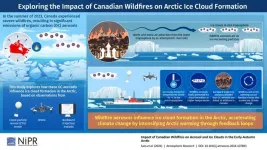
Clouds, composed of tiny water droplets or ice crystals, play a vital role in regulating Earth’s climate by influencing the amount of solar radiation that reaches the surface. The cloud phase significantly impacts the surface energy balance as liquid water clouds reflect more radiation than ice clouds. Ice clouds typically form at temperatures below −38°C, but recent observations indicate their formation at higher temperatures in the Arctic. This phenomenon is facilitated by ice-nucleating particles (INPs), including mineral dust, organic aerosols and bioaerosols, which promote ice cloud formation above the usual freezing ...

Read the release
How animal poop helps ecosystems adapt to climate change
Environment

How animal poop helps ecosystems adapt to climate change

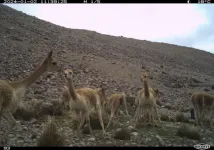
Climate change is melting away glaciers around the world, but in the Andes Mountains, a wild relative of the llama is helping local ecosystems adapt to these changes by dropping big piles of dung. This finding, published Dec 30 in Scientific Reports, revealed that the activity of this animal could accelerate the time plants usually take to establish on new land by over a century, highlighting a surprising way organisms are adapting to climate change. “It’s interesting to see how a social behavior of these animals ...

Read the release
Scientists discover unique microbes in Amazonian peatlands that could influence climate change
Environment

Scientists discover unique microbes in Amazonian peatlands that could influence climate change

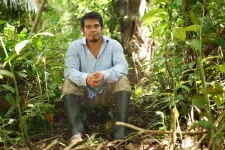
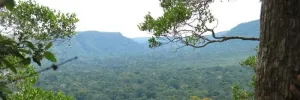
Complex organisms, thousands of times smaller than a grain of sand, can shape massive ecosystems and influence the fate of Earth's climate, according to a new study. Researchers from Arizona State University, along with their colleagues from the National University of the Peruvian Amazon, have identified an unknown family of microbes uniquely adapted to the waterlogged, low-oxygen conditions of tropical peatlands in Peru’s northwestern Amazonian rainforest. The new research shows these microbes have a dual role in the carbon cycle and the potential to either ...

Read the release
Environment

What to do with aging solar panels?

The National Science Foundation Convergence Accelerator Program has granted $5 million dollars to Phase 2 of the project “Securing critical material supply chains by enabling phOtovoltaic circuLARity (SOLAR).” SOLAR’s goal is to proactively ensure circularity of solar panels by providing solutions to barriers throughout the end-to-end supply chain. The intent is to make solar panels recyclable and find a solution to remanufacturing them at a competitive cost. Achieving this will help promote a clean and resilient energy system in the United States. The three-year project is led by Battelle Memorial Institute ...

Read the release
Environment

Scientists predict what will be top of the crops in UK by 2080 due to climate change

While climate change is likely to present significant challenges to agriculture in coming decades, it could also mean that crops such as chickpeas, soyabeans and oranges are widely grown across the UK, and home-produced hummus, tofu and marmalade are a common sight on our supermarket shelves by 2080. A new study led by the UK Centre for Ecology & Hydrology (UKCEH) in collaboration with the University of East Anglia (UEA) predicts that future warmer temperatures in this country would be suitable for a variety ...

Read the release
In a landmark study, an NYBG scientist and colleagues find that reforestation stands out among plant-based climate-mitigation strategies as most beneficial for wildlife biodiversity
Environment

In a landmark study, an NYBG scientist and colleagues find that reforestation stands out among plant-based climate-mitigation strategies as most beneficial for wildlife biodiversity

Bronx, NY—In the global effort to combat climate change, large-scale, plant-based strategies such as planting forests and cultivating biofuels are an increasingly important part of countries’ plans to reduce their overall carbon emissions, but a landmark new study in the journal Science finds that well-intended strategies could have unforeseen impacts on biodiversity and that, in general, restoring forests has the most beneficial effect on wildlife. The authors, including New York Botanical Garden (NYBG) Assistant Curator Evelyn Beaury, Ph.D., argue that policy makers and conservation officials should consider impacts on biodiversity when evaluating the ...

Read the release
Environment

More acidic oceans may affect the sex of oysters

Rising carbon dioxide levels affect more than just the climate; they also affect the chemistry of the oceans. When saltwater absorbs carbon dioxide, it becomes acidic, which alters the aquatic animal ecosystem. But how exactly does ocean acidification impact animals whose genetic makeup can shift depending on environmental cues? A study published in ACS’ Environmental Science & Technology addresses this question through the “eyes” of oysters. Oysters, unlike mammals and birds, do not have chromosomes that dictate their sex at the ...

Read the release
Environment

Reforestation boosts biodiversity, while other land-based climate mitigation strategies fall short

Reforestation is a win-win for climate and wildlife, but large-scale afforestation and bioenergy cropping may do more harm than good, according to a new study of land-based climate mitigation strategies (LBMS) for over 14,000 species. The findings emphasize the need to ensure well-intentioned climate action does not exacerbate biodiversity loss. While reducing greenhouse gas emissions is critical, increasing atmospheric carbon removal is equally essential to effectively combat climate change. LBMS considered among the most scalable ...

Read the release
Environment

Seasonal vertical migrations limit role of krill in deep-ocean carbon storage

The vertical migration of Antarctic krill may play a smaller role in oceanic carbon storage than previously believed, according to a year-long study in the Southern Ocean. The findings challenge conventional assumptions about the animal’s role in deep ocean carbon sequestration and underscore the need for more nuanced biogeochemical models incorporating ecological complexity. “Antarctic krill play an important role in the biological carbon pump, but without observational data, we risk using inaccurate and misleading assumptions about behaviors that influence carbon export and ...

Read the release
Super enzyme that regulates testosterone levels in males discovered in ‘crazy’ bird species
Environment

Super enzyme that regulates testosterone levels in males discovered in ‘crazy’ bird species

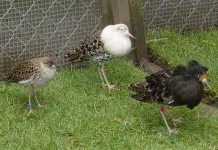
A single gene that regulates testosterone levels in a “crazy” species of shore bird controls the development of three wildly different types of males, an international study involving researchers at Simon Fraser University has found. Ruffs have long fascinated scientists for their three types of males, known as morphs, that differ radically from each other in appearance and mating behaviours. A new study published on the cover of the journal Science this month has discovered that these morphs are produced by a super enzyme (HSD17B2) ...

Read the release
Environment

Rare pterosaur fossil reveals crocodilian bite 76m years ago

The fossilised neck bone of a flying reptile unearthed in Canada shows tell-tale signs of being bitten by a crocodile-like creature 76 million years ago, according to a new study published today [23 January] in the Journal of Palaeontology. The juvenile pterosaur vertebra, discovered in Dinosaur Provincial Park, Alberta, bears a circular four-millimetre-wide puncture mark from a crocodilian tooth. Researchers from the Royal Tyrrell Museum of Palaeontology (Canada), the University of Reading (UK) and the University of New England (Australia) say this rare evidence provides insight into predator-prey dynamics ...

Read the release
Anti-climate action groups tend to arise in countries with stronger climate change efforts
Environment

Anti-climate action groups tend to arise in countries with stronger climate change efforts

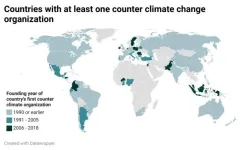
A new study suggests that countries with stronger commitments to protect the natural environment—regardless of national oil dependence or other economic interests—are more likely to see the establishment of counter climate change groups that aim to obstruct climate change action. Jared Furuta and Patricia Bromley of Stanford University, U.S., present these findings in the open-access journal PLOS One on January 22, 2025. Prior research has highlighted how the fossil fuel industry and conservative think tanks and philanthropists have stoked climate change skepticism in the U.S. in order to serve their economic ...

Read the release
Extent of microfibre pollution from textiles to be explored at new research hub
Environment

Extent of microfibre pollution from textiles to be explored at new research hub

A newly established research hub in North East England will explore the extent and environmental impact of microfibre loss from textiles. Microfibre shedding from clothing during machine washing and drying is well known, with the tiny fibres causing harm to wildlife and the environment when they enter soil, air and waterways. Located on Northumbria University’s campus in the centre of Newcastle, the Fibre-fragmentation and Environment Research Hub (FibER Hub) is the result of a collaboration between the University and The Microfibre Consortium (TMC) and will extensively test a wide variety ...

Read the release
Extreme climate pushed thousands of lakes in West Greenland ‘across a tipping point,’ study finds
Environment

Extreme climate pushed thousands of lakes in West Greenland ‘across a tipping point,’ study finds

West Greenland is home to tens of thousands of blue lakes that provide residents drinking water and sequester carbon from the atmosphere. Yet after two months of record heat and precipitation in fall 2022, an estimated 7,500 lakes turned brown, began emitting carbon and decreased in water quality, according to a new study. Led by Fulbright Distinguished Arctic Scholar and University of Maine Climate Change Institute Associate Director Jasmine Saros, a team of researchers found that the combination of extreme climate events in fall 2022 caused ecological change that ...

Read the release
From the original Press-News collection. Issuers of news releases are responsible for the accuracy of their content.