THE ORIGINAL COLLECTION · SINCE 2010

Space
press releases.

Research announcements from universities, hospitals and scientific institutions. Explore the stories, people and discoveries behind the headlines.

Original publication datesPage 26
FIND A STORY

Find a past release.

Dates and source material belong to the original release.

Read our research explainers

Browse the collection · original publication order

Star clusters observed within a galaxy in the early Universe for the first time
Space

Star clusters observed within a galaxy in the early Universe for the first time

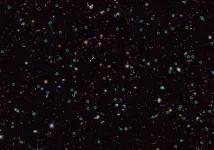
The history of how stars and galaxies came to be and evolved into the present day remains among the most challenging astrophysical questions to solve yet, but new research brings us closer to understanding it. In a new study by an international team led by Dr. Angela Adamo at Stockholm University, new insights about young galaxies during the Epoch of Reionization have been revealed. Observations with the James Webb Space Telescope (JWST) of the galaxy Cosmic Gems arc (SPT0615-JD) have confirmed that the light of the galaxy was emitted 460 million years after ...

Read the release
NASA astronaut Woody Hoburg to deliver keynote address at ISSRDC focused on developing a space workforce
Space

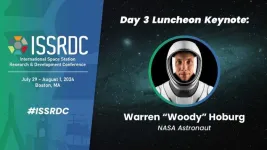
NASA astronaut Woody Hoburg to deliver keynote address at ISSRDC focused on developing a space workforce

BOSTON (MA), June 20, 2024 – NASA astronaut Warren “Woody” Hoburg will deliver a keynote address at the International Space Station Research and Development Conference (ISSRDC) in Boston on Thursday, August 1, 2024. Hoburg has close ties to Boston as a graduate and former assistant professor of aeronautics and astronautics at the Massachusetts Institute of Technology (MIT). Hoburg’s address will focus on his six-month science expedition on the space station and the importance of shaping the future workforce ...

Read the release
Supermassive black hole appears to grow like a baby star
Space

Supermassive black hole appears to grow like a baby star

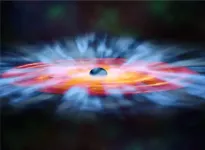
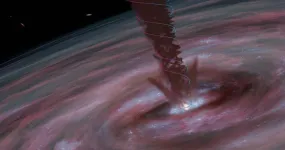
Supermassive black holes pose unanswered questions for astronomers around the world, not least “How do they grow so big?” Now, an international team of astronomers, including researchers from Chalmers University of Technology in Sweden, has discovered a powerful rotating, magnetic wind that they believe is helping a galaxy’s central supermassive black hole to grow. The swirling wind, revealed with the help of the ALMA telescope in nearby galaxy ESO320-G030, suggests that similar processes are involved both in black hole growth and the birth of stars. Most galaxies, including our own Milky Way have a supermassive black hole at their centre. How ...

Read the release
Illinois-led study reveals stable soil moisture variability within fields and opens the door for satellite remote sensing for future measurements
Space

Illinois-led study reveals stable soil moisture variability within fields and opens the door for satellite remote sensing for future measurements

A multi-institutional study led by University of Illinois and Agroecosystem Sustainability Center (ASC) scientists concluded that, although soil moisture varies significantly both within a single field and from field to field due to varying soil properties and different management practices, soil moisture distribution relative to the field average remains consistent across time within each field. Over three years, the team used sensor measurements and a high-density campaign to reveal that the drier areas remain the drier areas and the wetter areas remain the wetter areas. The study also deduced this finding, reliable estimations of ...

Read the release
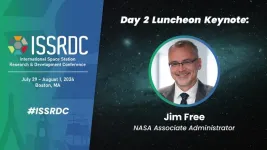
NASA Associate Administrator Jim Free to deliver keynote address at ISSRDC
Space

NASA Associate Administrator Jim Free to deliver keynote address at ISSRDC

BOSTON (MA), June 18, 2024 – Jim Free, associate administrator for NASA, will deliver a keynote address on Wednesday, July 31, at the International Space Station Research and Development Conference (ISSRDC) in Boston. Free, the senior advisor to Administrator Bill Nelson and Deputy Administrator Pam Melroy, is NASA’s third highest-ranking executive and its highest-ranking civil servant. In addition to leading the agency’s 10 center directors and the mission directorate associate administrators at NASA Headquarters ...

Read the release
Space

NASA selects Lockheed Martin to build next-gen spacecraft for NOAA

NASA, on behalf of the National Oceanic and Atmospheric Administration (NOAA), has selected Lockheed Martin Corp. of Littleton, Colorado, to build the spacecraft for NOAA’s Geostationary Extended Observations (GeoXO) satellite program. This cost-plus-award-fee contract is valued at approximately $2.27 billion. It includes the development of three spacecraft as well as four options for additional spacecraft. The anticipated period of performance for this contract includes support for 10 years of on-orbit operations and five years of on-orbit storage, for a total of 15 years for each spacecraft. ...

Read the release
Astronomers see a massive black hole awaken in real time
Space

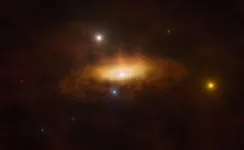
Astronomers see a massive black hole awaken in real time

In late 2019 the previously unremarkable galaxy SDSS1335+0728 suddenly started shining brighter than ever before. To understand why, astronomers have used data from several space and ground-based observatories, including the European Southern Observatory’s Very Large Telescope (ESO’s VLT), to track how the galaxy’s brightness has varied. In a study out today, they conclude that they are witnessing changes never seen before in a galaxy — likely the result of the sudden awakening of the massive black hole at its core. “Imagine you’ve been observing a distant galaxy for years, and it always seemed calm and inactive,” ...

Read the release
Laying the foundation for lunar base construction; elucidating lunar soil-microwave interactions
Space

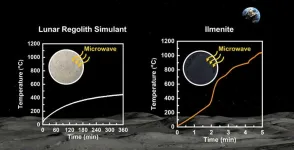
Laying the foundation for lunar base construction; elucidating lunar soil-microwave interactions

The United States’ NASA aims to construct a lunar base through the Artemis program, a manned lunar exploration initiative. However, the practical reality of what general public envision for the space base differs somewhat from well-known science fiction movies. To build a base on the Moon using abundant and diverse construction materials, significant transportation costs are involved. All these materials must be launched from Earth using rockets. Because transporting construction materials from Earth to the ...

Read the release
Investigating the origins of the crab nebula with NASA's Webb
Space

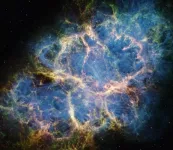
Investigating the origins of the crab nebula with NASA's Webb

A team of scientists used NASA’s James Webb Space Telescope to parse the composition of the Crab Nebula, a supernova remnant located 6,500 light-years away in the constellation Taurus. With the telescope’s MIRI (Mid-Infrared Instrument) and NIRCam (Near-Infrared Camera), the team gathered data that is helping to clarify the Crab Nebula’s history. The Crab Nebula is the result of a core-collapse supernova from the death of a massive star. The supernova explosion itself was seen on Earth in 1054 CE and was bright enough to view during the daytime. The much fainter remnant observed today ...

Read the release
Space

Watery planets orbiting dead stars may be good candidates for studying life — if they can survive long enough

The small footprint and dim light of white dwarfs, remnants of stars that have burned through their fuel, may make excellent backdrops for studying planets with enough water to harbor life. The trick is spotting the shadow of a planet against a former star that has withered to a fraction of its size and finding that it’s a planet that has kept its water oceans for billions of years even after riding out the star’s explosive and violent final throes. A new study of the dynamics of white dwarf systems suggests that, in theory, some watery planets may indeed thread the celestial needles necessary to await ...

Read the release
Giant Magellan Telescope enclosure ready for construction
Space

Giant Magellan Telescope enclosure ready for construction

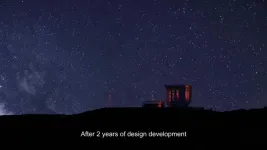
PASADENA, CA – June 13, 2024 – The Giant Magellan Telescope and IDOM today announced that the telescope’s enclosure, set to be one of the world’s largest astronomical facilities, passed its final design review and is now ready for construction in Chile. The review marks a major milestone for the telescope, which is now 40% under construction and on track to be operational by the early 2030s. “A team of ten international subject matter experts validated two years of design work by IDOM and the Giant Magellan Telescope. The final design of the enclosure is unique and an important feat of technical management, design, and engineering. We are very grateful ...

Read the release
Wind from black holes may influence development of surrounding galaxies
Space

Wind from black holes may influence development of surrounding galaxies

Clouds of gas in a distant galaxy are being pushed faster and faster — at more than 10,000 miles per second — out among neighboring stars by blasts of radiation from the supermassive black hole at the galaxy’s center. It’s a discovery that helps illuminate the way active black holes can continuously shape their galaxies by spurring on or snuffing out the development of new stars. A team of researchers led by University of Wisconsin–Madison astronomy professor Catherine Grier and recent graduate Robert Wheatley revealed the accelerating gas using years of data collected from a quasar, a particularly ...

Read the release
Mizzou scientists spot more Milky Way-like galaxies in early universe
Space

Mizzou scientists spot more Milky Way-like galaxies in early universe

University of Missouri scientists are peering into the past and uncovering new clues about the early universe. Since light takes a long time to travel through space, they are now able to see how galaxies looked billions of years ago. In a new study, the Mizzou researchers have discovered that spiral galaxies were more common in the early universe than previously thought. “Scientists formerly believed most spiral galaxies developed around 6 to 7 billion years after the universe formed,” said Yicheng Guo, an associate professor in Mizzou’s ...

Read the release
How do supermassive black holes get super massive?
Space

How do supermassive black holes get super massive?

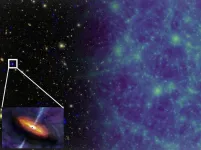
UNIVERSITY PARK, Pa. — By combining forefront X-ray observations with state-of-the-art supercomputer simulations of the buildup of galaxies over cosmic history, researchers have provided the best modeling to date of the growth of the supermassive black holes found in the centers of galaxies. Using this hybrid approach, a research team led by Penn State astronomers derived a complete picture of black-hole growth over 12 billion years, from the Universe’s infancy at around 1.8 billion years old to now at 13.8 billion years old. The research comprises two papers, ...

Read the release
Space

Would astronauts’ kidneys survive a roundtrip to Mars?

The structure and function of the kidneys is altered by space flight, with galactic radiation causing permanent damage that would jeopardise any mission to Mars, according to a new study led by researchers from UCL. The study, published in Nature Communications, is the largest analysis of kidney health in space flight to date and includes the first health dataset for commercial astronauts. It is published as part of a Nature special collection of papers on space and health. Researchers have known that space flight causes certain health issues since the 1970s, in the ...

Read the release
Hubble finds surprises around a star that erupted 40 years ago
Space

Hubble finds surprises around a star that erupted 40 years ago

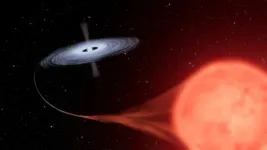
Astronomers have used new data from NASA's Hubble Space Telescope and the retired SOFIA (Stratospheric Observatory for Infrared Astronomy) as well as archival data from other missions to revisit one of the strangest binary star systems in our galaxy – 40 years after it burst onto the scene as a bright and long-lived nova. A nova is a star that suddenly increases its brightness tremendously and then fades away to its former obscurity, usually in a few months or years. Between April and September 1975, the binary system HM Sagittae (HM Sge) grew 250 times brighter. Even more unusual, it did not rapidly fade away as novae commonly do, but has ...

Read the release
NASA’s Webb opens new window on supernova science
Space

NASA’s Webb opens new window on supernova science

Peering deeply into the cosmos, NASA’s James Webb Space Telescope is giving scientists their first detailed glimpse of supernovae from a time when our universe was just a small fraction of its current age. A team using Webb data has identified 10 times more supernovae in the early universe than were previously known. A few of the newfound exploding stars are the most distant examples of their type, including those used to measure the universe's expansion rate. "Webb is a supernova ...

Read the release
Lone Star State: Tracking a low-mass star as it speeds across the Milky Way
Space

Lone Star State: Tracking a low-mass star as it speeds across the Milky Way

It may seem like the Sun is stationary while the planets in its orbit are moving, but the Sun is actually orbiting around the Milky Way galaxy at an impressive rate of about 220 kilometers per second — almost half a million miles per hour. As fast as that may seem, when a faint red star was discovered crossing the sky at a noticeably quick pace, scientists took notice. Thanks to the efforts of a citizen science project called Backyard Worlds: Planet 9 and a team of astronomers from around the country, a rare hypervelocity ...

Read the release
Webb telescope reveals asteroid collision in neighboring star system
Space

Webb telescope reveals asteroid collision in neighboring star system

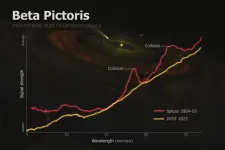
Astronomers have captured what appears to be a snapshot of a massive collision of giant asteroids in Beta Pictoris, a neighboring star system known for its early age and tumultuous planet-forming activity. The observations spotlight the volatile processes that shape star systems like our own, offering a unique glimpse into the primordial stages of planetary formation. “Beta Pictoris is at an age when planet formation in the terrestrial planet zone is still ongoing through giant asteroid collisions, so what we could be seeing here is basically how rocky planets and other bodies are forming in real time,” said Christine Chen, a Johns Hopkins University astronomer ...

Read the release

Space

In new experiment, scientists record Earth’s radio waves from the moon

On Feb. 22, a lunar lander named Odysseus touched down near the Moon’s South Pole and popped out four antennas to record radio waves around the surface—a moment University of Colorado Boulder astrophysicist Jack Burns hails as the “dawn of radio astronomy from the Moon.” It was a major achievement for the tenacious lander, which was built by the Houston-based company Intuitive Machines and had to overcome a series of technical difficulties to make it to the lunar surface. Burns is co-investigator on the radio experiment that flew aboard Odysseus called Radio wave Observations at the Lunar Surface ...

Read the release
Space

New research finds lake under Mars ice cap unlikely

ITHACA, N.Y. – Cornell University researchers have provided a simple and comprehensive – if less dramatic – explanation for bright radar reflections initially interpreted as liquid water beneath the ice cap on Mars’ south pole. Their simulations show that small variations in layers of water ice – too subtle for ground-penetrating radar instruments to resolve – can cause constructive interference between radar waves. Such interference can produce reflections whose intensity and variability match observations to date – not only in the area proposed to be liquid water, but across the so-called south ...

Read the release
Earth and space share the same turbulence
Space

Earth and space share the same turbulence

Fukuoka, Japan—In a paper published in Geophysical Research Letters, researchers have discovered that the turbulence in the thermosphere exhibits the same physical laws as the wind in the lower atmosphere. Furthermore, wind in the thermosphere predominantly rotates in a cyclonic direction, in that it rotates counterclockwise in the Northern Hemisphere and clockwise in the Southern Hemisphere. The findings reveal a new unified principle for the Earth’s varied environmental systems and can potentially improve future forecasting of both earth and space weather. One time or another we’ve tuned in to see the latest weather forecast, and while ...

Read the release
Space

JWST uncovers features of very-low-mass star’s protoplanetary disk that influence planet composition

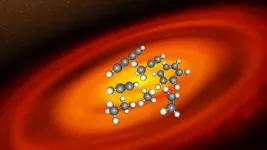
James Webb Space Telescope (JWST) observations have revealed abundant hydrocarbons in the protoplanetary disk surrounding a young, very-low-mass star – findings that provide novel insights into the chemical environment from which many terrestrial planets, in particular, are born. Planets form in disks of gas and dust that orbit young stars. Observations show that terrestrial planets form more efficiently than gas giant planets around very-low-mass stars (VLMSs) – those with less than 0.3 solar masses. Although the chemical compositions of the inner disk regions around higher mass stars ...

Read the release
Planet-forming disks around very low-mass stars are different
Space

Planet-forming disks around very low-mass stars are different

Planets form in disks of gas and dust, orbiting young stars. The MIRI Mid-INfrared Disk Survey (MINDS), led by Thomas Henning from the Max Planck Institute for Astronomy (MPIA) in Heidelberg, Germany, aims to establish a representative disk sample. By exploring their chemistry and physical properties with MIRI (Mid-Infrared Instrument) on board the James Webb Space Telescope (JWST), the collaboration links those disks to the properties of planets potentially forming there. In a new study, a team of researchers ...

Read the release
Marsupials key to discovering the origin of heater organs in mammals
Space

Marsupials key to discovering the origin of heater organs in mammals

Around 100 million years ago, a remarkable evolutionary shift allowed placental mammals to diversify and conquer many cold regions of our planet. New research from Stockholm University shows that the typical mammalian heater organ, brown fat, evolved exclusively in modern placental mammals. In collaboration with the Helmholtz Munich and the Natural History Museum Berlin in Germany, and the University of East Anglia in the U.K., the Stockholm research team demonstrated that marsupials, our distant relatives, possess a not fully evolved form of brown fat. They discovered that the pivotal heat-producing protein called ...

Read the release
From the original Press-News collection. Issuers of news releases are responsible for the accuracy of their content.