THE ORIGINAL COLLECTION · SINCE 2010

Technology
press releases.

Research announcements from universities, hospitals and scientific institutions. Explore the stories, people and discoveries behind the headlines.

Original publication datesPage 147
FIND A STORY

Find a past release.

Dates and source material belong to the original release.

Read our research explainers

Browse the collection · original publication order

Promising building blocks for photonic quantum simulators
Technology

Promising building blocks for photonic quantum simulators

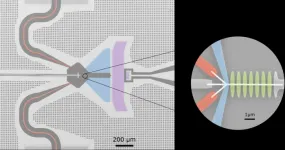
Researchers at the Niels Bohr Institute have, collaborating with the University of Münster and Ruhr-Universität Bochum, developed new technology capable of processing the enormous amounts of information quantum systems generate. Deterministic single photon light sources, creating quantum bits at extreme rates and speed are now coupled to specially designed, integrated photonic circuits, capable of processing quantum information with adequate speed and quality without degrading the susceptible quantum states. This means that the first steps have been taken towards the development of photonic quantum devices that can, for example, ...

Read the release
Army funds two quantum-related projects at Pitt
Technology

Army funds two quantum-related projects at Pitt

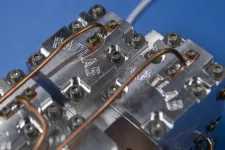
The U.S. Army has awarded more than $5.7 million for two projects led by Michael Hatridge, associate professor of physics and astronomy in the Kenneth P. Dietrich School of Arts and Sciences. Both projects bring together a diverse group of researchers to overcome roadblocks in the field of quantum computing. A four-year, $2.67 million grant is aimed at the next generation of modular quantum computing systems. Hatridge and co-principal investigators Robert Schoelkopf of Yale University have each developed unique ...

Read the release
Technology

Defence lawyers face challenges accessing and reviewing digital evidence, study shows

Defence lawyers face numerous challenges accessing and reviewing evidence from phones and computers, a new study shows. Solicitors and barristers have reported their use of digital evidence can be restricted by limited or late access, large volumes of material, and tight turnaround times to secure legal aid funding and choose and instruct independent experts. The research calls for more clarity and transparency around the collection and analysis of digital evidence and the streamlining of the format and presentation of information. The current volume and diversity of digital evidence available escalates tensions, delays access to digital ...

Read the release
Quantum sensor for a future navigation system tested aboard Royal Navy ship
Technology

Quantum sensor for a future navigation system tested aboard Royal Navy ship

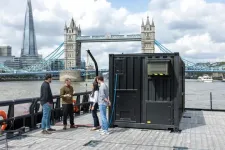
A prototype quantum sensor with potential applications in GPS-free navigation, developed at Imperial College London, has been tested in collaboration with the Royal Navy. The test marks an important step in bringing new quantum technologies out of the lab and into real-world settings. Many navigation systems today rely on global navigation satellite systems (GNSS), such as GPS, which uses signals from satellites orbiting the Earth. However, GPS navigation is not always accessible, obstacles like tall buildings can easily block the satellite signals, and they are also susceptible ...

Read the release
Technology

Forging a dream material with semiconductor quantum dots

Researchers from the RIKEN Center for Emergent Matter Science and collaborators have succeeded in creating a “superlattice” of semiconductor quantum dots that can behave like a metal, potentially imparting exciting new properties to this popular class of materials. Semiconducting colloidal quantum dots have garnered tremendous research interest due to their special optical properties, which arise from the quantum confinement effect. They are used in solar cells, where they can improve the efficiency of energy conversion, biological imaging, where they can be used as fluorescent probes, electronic displays, and even quantum computing, where their ability to ...

Read the release
A celebration of artificial light sources
Technology

A celebration of artificial light sources

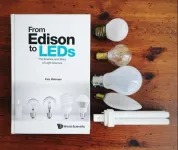
Did you know that until the early twentieth century, artificial light sources only served the purpose of illuminating our surroundings? Since then, significant changes have taken place. Light is now utilized in various ways beyond just space illumination. From semiconductor chip manufacturing to high-speed data communications, the increasing number of applications has led to the development of different kinds of light-producing devices. Some light sources even generate light through radioactive decays! If you have wondered how we managed to progress from a simple lightbulb to energy-efficient LEDs, put your doubts to rest now. Delve into From Edison to LEDs: The Science and ...

Read the release
Helping virtual reality reflect social realities
Technology

Helping virtual reality reflect social realities

Research on virtual reality is expanding as the technology grows, but too much of that research is being conducted with participants who don’t reflect the general population. The Virtual Experience Research Accelerator (VERA), a $5 million National Science Foundation-funded project, is creating a system to provide researchers with access to large, reliable, diverse groups of participants for an array of research projects on and using VR. “A lot of research in this area suffers from using participant samples ...

Read the release
Chip-based QKD achieves higher transmission speeds
Technology

Chip-based QKD achieves higher transmission speeds

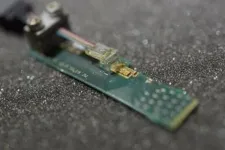
WASHINGTON — Researchers have developed a quantum key distribution (QKD) system based on integrated photonics that can transmit secure keys at unprecedented speeds. The proof-of-principle experiments represent an important step toward real-world application of this highly secure communication method. QKD is a well-established method of providing secret keys for secure communication between distant parties. By using the quantum properties of light to generate secure random keys for encrypting and ...

Read the release
Researchers at the Faculty of Physics of the University of Warsaw have created a new, highly efficient converter of quantum information carriers
Technology

Researchers at the Faculty of Physics of the University of Warsaw have created a new, highly efficient converter of quantum information carriers

Researchers at the University of Warsaw's Faculty of Physics have developed a new, highly efficient technique that makes quantum information transmission dozens of times faster. The results of the research, published in the prestigious journal Nature Photonics, may in the near future contribute to the development of superfast quantum Internet connections. Light is a key carrier of information. It enables high-speed data transmission around the world via fiber-optic telecommunication networks. This information-carrying capability can be extended to transmitting quantum information by encoding ...

Read the release
Technology

Microneedling plus cupping may aid skin rejuvenation

May 25, 2023 – A combination of emerging and alternative techniques – microneedling to induce collagen and cupping to increase tissue perfusion – may have a synergistic effect in producing skin rejuvenation, according to an experimental study in the June issue of Plastic and Reconstructive Surgery®, the official medical journal of the American Society of Plastic Surgeons (ASPS). The journal is published in the Lippincott portfolio by Wolters Kluwer. "Cupping therapy can be added to microneedling therapy and used to increase certain desired effects on skin," comments lead author Burak Pasinlioğlu, MD, of Kecioren Research ...

Read the release
CityU researchers develop a self-supervised AI adaptation framework to enhance sensing accuracy of EMG devices
Technology

CityU researchers develop a self-supervised AI adaptation framework to enhance sensing accuracy of EMG devices

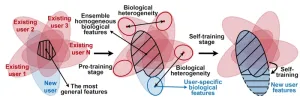
Surface electromyography (EMG) has been widely used to measure the electrical activity of muscles. However, the variability in EMG sensing signals due to biological differences of different users significantly degrades the performance and potential of EMG systems. Recently, researchers from City University of Hong Kong (CityU) developed a deep learning-based framework called EMGSense, which can achieve high sensing performance for new users using AI self-training techniques. This opens a new path for developing more advanced and accurate wearable EMG devices in areas like neurorehabilitation and virtual reality. This ...

Read the release
Quantum scientists accurately measure power levels one trillion times lower than usual
Technology

Quantum scientists accurately measure power levels one trillion times lower than usual

Scientists in Finland have developed a nanodevice that can measure the absolute power of microwave radiation down to the femtowatt level at ultra-low temperatures – a scale trillion times lower than routinely used in verifiable power measurements. The device has the potential to significantly advance microwave measurements in quantum technology. Measuring extremely low power Quantum science takes place mostly at ultra-low temperatures using devices called dilution refrigerators. ...

Read the release
Technology

Scientists propose revolution in complex systems modelling with quantum technologies

Scientists have made a significant advancement with quantum technologies that could transform complex systems modelling with an accurate and effective approach that requires significantly reduced memory. Complex systems play a vital role in our daily lives, whether that be predicting traffic patterns, weather forecasts, or understanding financial markets. However, accurately predicting these behaviours and making informed decisions relies on storing and tracking vast information from events in the distant past – a process which presents huge challenges. Current models using artificial intelligence see their ...

Read the release
Successful terahertz wireless communication using a micro-resonator soliton comb: Expectations for next-generation mobile communications based on photonic technology
Technology

Successful terahertz wireless communication using a micro-resonator soliton comb: Expectations for next-generation mobile communications based on photonic technology

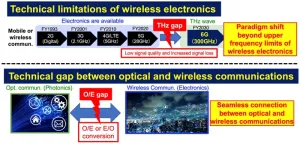
Key points Wireless electronics that have been used thus far in next-generation mobile communications using terahertz waves may reach their technical limit (namely, upper limit of frequency for wireless electronics). Terahertz wireless communication in the 560-GHz band was achieved by optical-to-electrical conversion of ultra-high-frequency photonic RF signals in near-infrared micro-resonator soliton comb. Adding the low-phase noise that is characteristic of micro-resonator soliton comb to terahertz waves makes it possible to achieve ultra-high-speed ...

Read the release
Recent UCLA computer grad constructs “Crown Jewel of Cryptography”
Technology

Recent UCLA computer grad constructs “Crown Jewel of Cryptography”

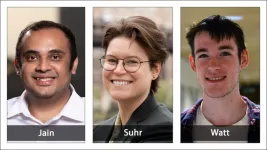
ACM, the Association for Computing Machinery, today announced that Aayush Jain receives the 2022 ACM Doctoral Dissertation Award for his dissertation “Indistinguishability Obfuscation from Well-Studied Assumptions,” which established the feasibility of mathematically rigorous software obfuscation from well-studied hardness conjectures. The central goal of software obfuscation is to transform source code to make it unintelligible without altering what it computes. Additional conditions may be added, such as requiring the transformed code to perform ...

Read the release
Quantum matter breakthrough: Tuning density waves
Technology

Quantum matter breakthrough: Tuning density waves

“Cold atomic gases were well known in the past for the ability to ‘program’ the interactions between atoms,” says Professor Jean-Philippe Brantut at EPFL. “Our experiment doubles this ability!” Working with the group of Professor Helmut Ritsch at the University of Innsbruck, they have made a breakthrough that can impact not only quantum research but quantum-based technologies in the future. Density waves Scientists have long been interested in understanding how materials self-organize into complex structures, such as crystals. In the often-arcane world of quantum physics, ...

Read the release
Technology

Use of AI: Placebo effect increases risk-taking

Human augmentation technologies refer to technological aids that enhance human abilities. They include things like exoskeletons, but also augmented reality headsets. A study at the Chair of Human-Centered Ubiquitous Media at LMU has now shown that users have high expectations of the effects of these technologies. As soon as they believe that AI is enhancing their cognitive abilities, they increase their risk-taking. And they do this independently of whether the AI is actually assisting them. “The hype around AI applications affects the expectations of users. This can lead to riskier behavior,” says Steeven Villa, doctoral researcher ...

Read the release
Engineers at UMass Amherst harvest abundant clean energy from thin air, 24/7
Technology

Engineers at UMass Amherst harvest abundant clean energy from thin air, 24/7

Researchers describe the “generic Air-gen effect”—nearly any material can be engineered with nanopores to harvest, cost effective, scalable, interruption-free electricity AMHERST, Mass. – A team of engineers at the University of Massachusetts Amherst has recently shown that nearly any material can be turned into a device that continuously harvests electricity from humidity in the air. The secret lies in being able to pepper the material with nanopores less than 100 nanometers in diameter. The research appeared in the journal Advanced Materials. “This is very exciting,” ...

Read the release
AI tool outperforms human emergency call handlers in identifying stroke, new study shows
Technology

AI tool outperforms human emergency call handlers in identifying stroke, new study shows

(24 May 2023, Munich, Germany) A team of researchers from Denmark have developed a new artificial intelligence (AI) framework to address the number of strokes that go unrecognised by human emergency call handlers.1 The framework outperformed emergency call handlers in recognising stroke for both sexes and across all age groups studied, indicating its potential as a supplementary tool for early and precise stroke identification in the future. The retrospective study, presented today at the European Stroke ...

Read the release
Technology

Breakthrough in computer chip energy efficiency could cut data center electricity use

CORVALLIS, Ore. – Researchers at Oregon State University and Baylor University have made a breakthrough toward reducing the energy consumption of the photonic chips used in data centers and supercomputers. The findings are important because a data center can consume up to 50 times more energy per square foot of floor space than a typical office building, according to the U.S. Department of Energy. A data center houses an organization’s information technology operations and equipment; it stores, processes and disseminates ...

Read the release
Researchers use nuclear spins neighboring a lanthanide atom in a crystal to create Greenberger-Horne-Zeilinger quantum states
Technology

Researchers use nuclear spins neighboring a lanthanide atom in a crystal to create Greenberger-Horne-Zeilinger quantum states

Researchers have experimentally demonstrated a new quantum information storage protocol that can be used to create Greenberger-Horne-Zeilinger (GHZ) quantum states. There is a great deal of interest in these complex entangled states because of their potential use in quantum sensing and quantum error correction applications. Chun-Ju Wu from the California Institute of Technology will present this research at the Optica Quantum 2.0 Conference and Exhibition, as a hybrid event 18-22 June in Denver, Colorado. Quantum-based technologies store information ...

Read the release
Boost for the quantum internet
Technology

Boost for the quantum internet

Quantum networks connect quantum processors or quantum sensors with each other. This allows tap-proof communication and high-performance distributed sensor networks. Between network nodes, quantum information is exchanged by photons that travel through optical waveguides. Over long distances, however, the likelihood of photons being lost increases dramatically. As quantum information cannot simply be copied and amplified, 25 years ago Hans Briegel, Wolfgang Dür, Ignacio Cirac and Peter Zoller, then all at the University of Innsbruck, provided the blueprints for a quantum repeater. These feature light-matter entanglement sources and memories ...

Read the release
Researchers build bee robot that can twist
Technology

Researchers build bee robot that can twist

PULLMAN, Wash. – A robotic bee that can fly fully in all directions has been developed by Washington State University researchers. With four wings made out of carbon fiber and mylar as well as four light-weight actuators to control each wing, the Bee++ prototype is the first to fly stably in all directions. That includes the tricky twisting motion known as yaw, with the Bee++ fully achieving the six degrees of free movement that a typical flying insect displays. Led by Néstor O. Pérez-Arancibia, Flaherty associate professor in WSU’s School of Mechanical and Materials Engineering, the researchers ...

Read the release
Technology

Texas A&M team studying effects of crypto mining on Texas power grid

Cryptocurrency transactions may be costing more than just transaction fees. The electricity used for these transactions is more than what some countries, like Argentina and Australia, use in an entire year. Published estimates of the total global electricity usage for cryptocurrency assets such as Bitcoin are between 120 and 240 billion kilowatt-hours per year, according to the White House Office of Science and Technology. The United States leads these numbers. Finance and business experts have debated the ramifications of cryptocurrency and mining, but ...

Read the release
Stretching metals at the atomic level allows researchers to create important materials for quantum, electronic, and spintronic applications
Technology

Stretching metals at the atomic level allows researchers to create important materials for quantum, electronic, and spintronic applications

A University of Minnesota Twin Cities-led team has developed a first-of-its-kind, breakthrough method that makes it easier to create high-quality metal oxide thin films out of “stubborn” metals that have historically been difficult to synthesize in an atomically precise manner. This research paves the way for scientists to develop better materials for various next-generation applications including quantum computing, microelectronics, sensors, and energy catalysis. The researchers’ paper is published in Nature Nanotechnology, ...

Read the release
From the original Press-News collection. Issuers of news releases are responsible for the accuracy of their content.