Magnetized polymer sheets snap open one row at a time — and absorb 30% more energy
North Carolina State University
What happens when you cut a pattern of T-shapes into a sheet of elastic polymer and pull? Every slit pops open at once, stretching the sheet into a mesh. The behavior is well understood. It is also, from an engineering standpoint, mostly useless — a single dramatic snap with no nuance, no sequencing, no control.
But what if you magnetized the sheet first? That was the question Haoze Sun and Jie Yin at North Carolina State University decided to test. The answer turned out to be more interesting than they expected.
From simultaneous snap to sequential cascade
A metamaterial is any material whose properties have been engineered through structural modification rather than chemical composition. Cut a repeating pattern into a polymer sheet and you have changed how it stretches, folds, and absorbs force. The cuts create a lattice of connected segments that, under tension, can flip open like tiny trap doors.
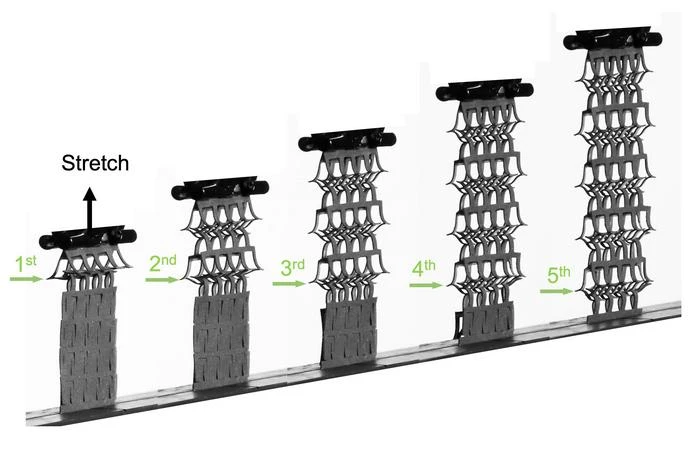
In an unmagnetized sheet, gravity pulling on the hanging material overwhelms the elastic resistance of every row simultaneously. All the cuts pop at once. The researchers embedded magnetic particles into the polymer before magnetizing the entire sheet. Now, the magnetic attraction between adjacent segments acts as an additional force holding the cuts closed — a force that gravity must overcome row by row rather than all at once.
The result: instead of a single snap, the sheet unfolds in a cascade. One row opens, then another, then another. The transition from simultaneous to sequential behavior is entirely a consequence of the magnetic field.
Why does each sheet pick its own order?
Here is where the physics becomes subtle. Each magnetized sheet does open sequentially, but the order in which the rows open appears random. Sheet A might open rows 1-2-3 from top to bottom. Sheet B, manufactured identically, might open 3-1-2. There is no obvious reason for one sequence over another.
But here is the surprising part: each sheet repeats its own order perfectly. Sheet A always opens 1-2-3. Sheet B always opens 3-1-2. The order is deterministic, just not predictable from the design alone.
The explanation lies in manufacturing imperfections. Tiny, unavoidable defects — microscopic variations in cut depth, magnetic particle distribution, or polymer thickness — create slight differences in the force balance at each row. These defects are fixed once the sheet is made, so they produce the same sequence every time. The randomness is not in the physics. It is in the fabrication.
Taming randomness with repulsion
Could you force a predictable order? The NC State team tried clamping two magnetized sheets back-to-back with their magnetic fields oriented to repel each other. The repulsive force between the sheets adds a position-dependent bias: rows at the top, where the sheets are clamped, experience different net forces than rows at the bottom, where they hang free.
This arrangement produced top-to-bottom sequential opening 90 percent of the time. Not perfect, but a dramatic improvement over the single-sheet randomness. The repulsive field gradient essentially overrides the defect-driven ordering, imposing a mechanical hierarchy that defects alone cannot scramble.
So the researchers demonstrated two levels of control. Magnetization converts simultaneous behavior into sequential behavior. Paired repulsive alignment converts random sequences into ordered ones.
Catching a ball that would otherwise bounce
Sequential snapping is not just a curiosity. Each row opening absorbs energy — the magnetic bonds resist separation, and that resistance dissipates kinetic energy as work. When all rows open simultaneously, the energy absorption happens in a single burst. When they open sequentially, it happens in stages, and the total amount of energy the material can absorb increases.
The numbers: the magnetized metamaterial absorbed 30 percent more kinetic energy than its unmagnetized counterpart. The researchers demonstrated this with a simple and vivid experiment. Drop a ball onto the unmagnetized sheet and it bounces. Drop the same ball onto the magnetized version and it comes to rest. The sequential row openings act as a series of energy sinks, each one removing a portion of the ball's kinetic energy until none remains.
The amount of energy absorbed scales with magnetic field strength. Stronger magnetization means stronger bonds to break, which means more energy consumed per row. This tunability is a practical advantage — the same base material can be calibrated for different impact scenarios by adjusting the magnetization level.
Metamaterials as programmable shock absorbers
Energy absorption is the most immediate application, but not the only one. Sequential snapping in a controlled order could guide how mechanical waves propagate through a material — useful in acoustic cloaking or vibration isolation. The ordered unfolding also has potential in soft robotics, where a sheet that reliably unfolds in a known sequence could serve as an actuator or a deployable structure.
The researchers note possible biomedical applications as well, though they did not demonstrate any in this study. Programmable mechanical metamaterials could find use in stents, deployable surgical tools, or protective equipment where controlled energy dissipation matters.
What remains to be tested
The study was conducted with a specific cut pattern (T-shaped slits), a specific polymer, and a specific magnetic particle loading. Whether the sequential snapping phenomenon generalizes to other geometries, other materials, and other scales is an open question. The 90 percent reliability of ordered opening in paired sheets is impressive but not 100 percent — the remaining 10 percent likely reflects cases where defects in the individual sheets are strong enough to override the repulsive gradient.
The experiments were also conducted under controlled laboratory conditions. Real-world energy absorption applications would involve variable temperatures, repeated impacts, material fatigue, and environmental exposure — none of which were tested here. The durability of the magnetic properties under cyclic loading is another unknown. Magnetic materials can demagnetize under repeated mechanical stress, which could erode the sequential behavior over time.
And while the ball-drop demonstration is intuitive, it is a far cry from the kind of standardized impact testing required for protective equipment or automotive safety applications. Translating the 30 percent energy absorption improvement into an engineering specification will require substantially more work.
A simple question with a layered answer
What began as a straightforward curiosity — does magnetism change how a cut sheet unfolds? — produced a cascade of findings about defect-driven ordering, controllable sequencing, and tunable energy absorption. The physics is elegant: magnetic forces add a hold-closed bias that gravity must overcome incrementally, manufacturing defects encode a hidden sequence, and paired repulsion imposes order on chaos.
Whether this translates into practical devices depends on engineering challenges the study does not address. But as a demonstration of how a single material modification — embedding magnetic particles — can transform the mechanical behavior of a metamaterial from trivial to programmable, the work opens genuine design possibilities.