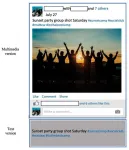
Social media posts may be viewed differently by others to how users perceive themselves
In a new study, viewers of Facebook users’ posts came away with perceptions of the users that differed from the users’ own self-perceptions. Qi Wang and colleagues at Cornell University, New York, US, present these findings in the open-access journal PLOS ONE on December 20, 2023. Many people post on social media platforms in order to express themselves and connect with others. Prior research has shown that viewers of personal websites, such as blogs or online profiles, form largely accurate perceptions ...
Read the release